Hank™'s Classroom
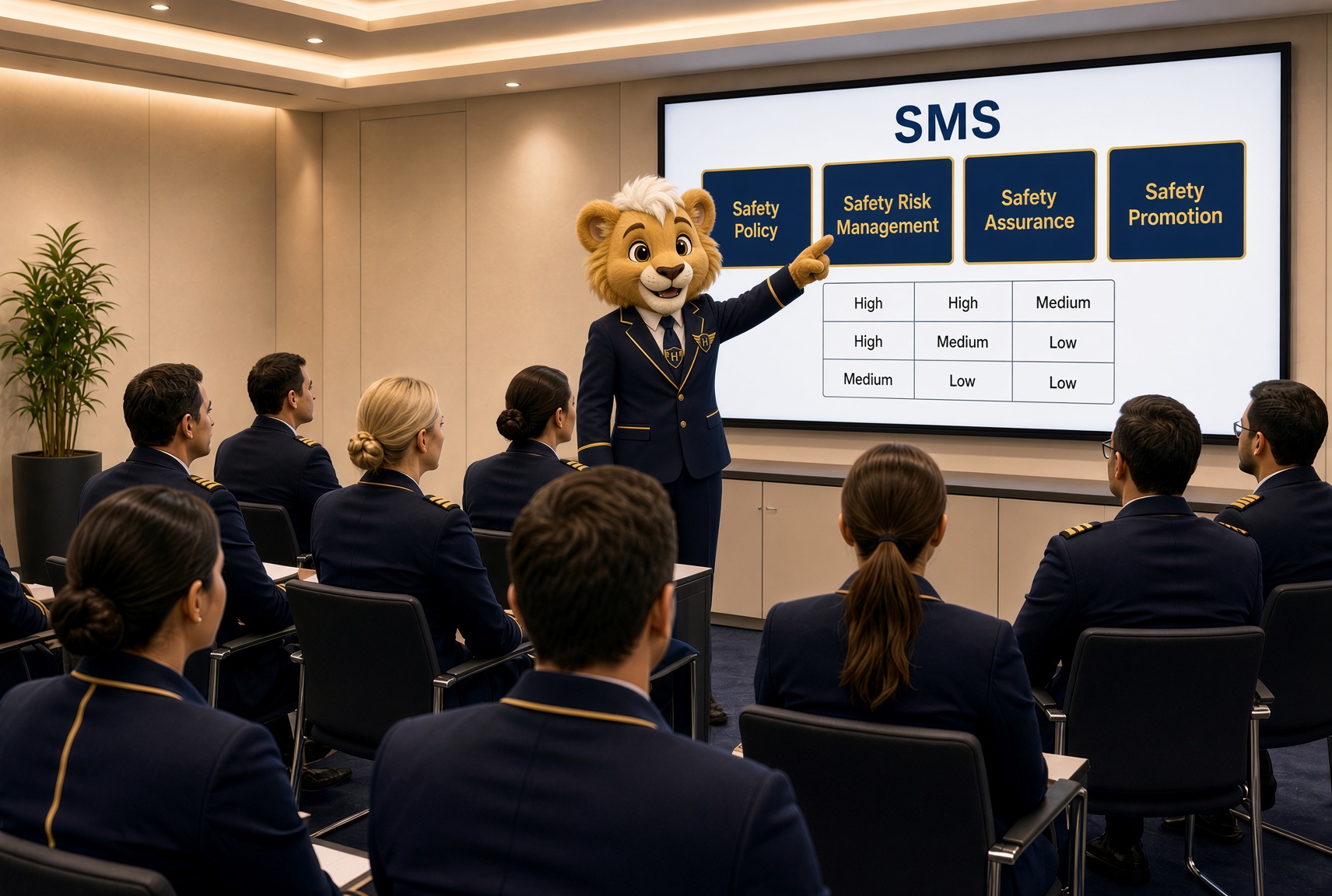
Safety lessons in plain language.
Hank breaks down real cases, SMS concepts, and practical safety tips — short reads for busy operators, no jargon.
Hank breaks down real cases, SMS concepts, and practical safety tips — short reads for busy operators, no jargon.
Each issue follows the same simple recipe: what happened, which safety piece was missing, and what a small operator can do about it this week.
Case file — what the NTSB found. On January 29, 2019, a Survival Flight Bell 407 air ambulance helicopter crashed in Zaleski, Ohio, killing all three aboard — the pilot, a flight nurse, and a flight paramedic. They were enroute to pick up a patient for hospital-to-hospital transport. The helicopter was certified for visual flight only. It flew into bands of snow showers; the pilot attempted a 180° turn, failed to maintain altitude, and struck trees and terrain.
The NTSB determined the cause as the operator's "inadequate management of safety," which led to the pilot departing without a thorough preflight weather evaluation. In post-accident interviews, Survival Flight employees said there was pressure from management to operate in challenging conditions and to accept flights that other air ambulance services had turned down for weather. The NTSB found pilots and operations staff routinely failed to comply with preflight risk assessment procedures because such noncompliance had become "normalized" by the operator's deficient safety culture. NTSB Chairman Robert Sumwalt: "This accident was all but invited by the actions and culture of Survival Flight." The NTSB further stated these risks "would likely have been identified and mitigated by a properly run safety management system, which could have prevented this crash." (All findings above: NTSB press release, May 19, 2020.)
Hank's take — the missing SMS piece. (Hank's teaching below; not NTSB wording.) In SMS terms, this maps to Safety Assurance — pillar three of the four SMS components.
Survival Flight had risk assessment procedures on paper. The problem: nobody checked whether anyone was actually using them. That is exactly what Safety Assurance is for — the monitoring, auditing, and data-review loop that verifies your safety processes work in real life, not just in the manual. When noncompliance becomes "how we do things here," that is also a culture problem (Safety Promotion, pillar four) — but it is Safety Assurance that catches it first, by asking: why are zero risk assessments being filed on night shifts?
The NTSB said it directly: these risks "would likely have been identified and mitigated by a properly run safety management system, which could have prevented this crash."
Your move — one minute. Pull your last 30 risk assessments (or flight risk analysis forms, whatever your operation calls them). Don't read them — count them. Are there really 30? Or are there gaps on busy nights, short turnarounds, or "routine" flights? A risk assessment form nobody fills out is not a safety process. It's a decoration.
Flying Part 135 without an SMS? The FAA's 2024 final rule requires one by May 2027. The NTSB has been recommending it since 2009. Our SMS training starts from exactly this kind of case.
8,600+ hours, no instrument rating, and a VFR flight into IMC at dusk. The NTSB final report ERA25FA119 on the Cessna 208 that went down near Pierson, Florida — and the last minute that was not where the decision belonged.
Six people, a JetProp at FL240, and a forecast that put icing probability at fifty percent. The NTSB preliminary report CEN27FA016 on the Piper PA-46 that went down near Reedsburg, Wisconsin — and the exit that had to be decided before takeoff.
Two words that are not a fuel order, 145 gallons of the wrong fuel, and a signed receipt that said so. The NTSB final report ERA26LA314 on the Cessna 421C that lost both engines — and the ninety-second sample that would have stopped it.
A 1,075-hour pilot, four weeks into a new job, flew a night air tour into a lighted tower in Houston. The NTSB's final report is less about the tower than about what the operator could not show investigators — a documented training program and pilot records. Includes the two-page fix any small operator can copy, a duty rule, and a route obstruction card.
From the FAA's 64-item medical kit proposal to Northwest 255 — why smart, experienced people skip checklists, and where the real fix lives.
What voluntary safety reporting is really for — and why the answer decides whether your reporting system collects truth or silence. How Just Culture and NASA's ASRS prove that reports only work when people aren't afraid.
Case file — a real, publicly-reported occurrence and what the investigation found.
The missing piece — which part of SMS (policy, risk management, assurance, or promotion) would have caught it.
Your move — one practical step a small operator can take right away.
Hank's Classroom is the appetizer. Our live training programs go deep — 16 to 24 hours, built around your operation.