What happened
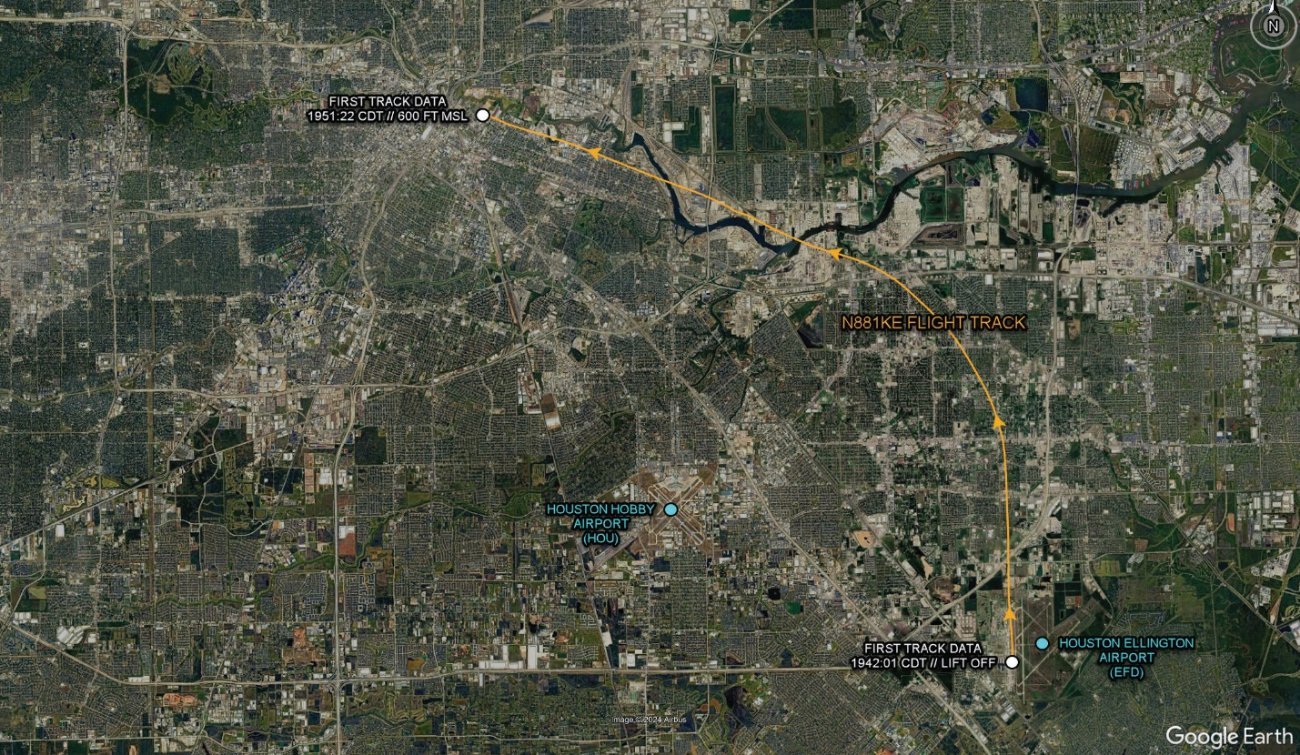
On the evening of October 20, 2024, a Robinson R44 II (N881KE) operated by National Helicopter Solutions departed Ellington Airport in Houston at about 7:42 p.m. on a night sightseeing flight. The pilot contacted the Houston Hobby tower and requested the "downtown loop." The final report notes that this was not a standard or published route — it was a general term some local helicopter pilots used for operating in the downtown area. The controller identified the helicopter on radar, approved the request, and issued the altimeter setting.
Several minutes later, the controller issued a traffic advisory for another company air tour helicopter, two miles away. The pilot replied that she could see the traffic on her ADS-B display but had not yet visually acquired it and was searching for it. The controller instructed her to maintain visual separation from the traffic. She was reading that instruction back when her transmission abruptly ended.
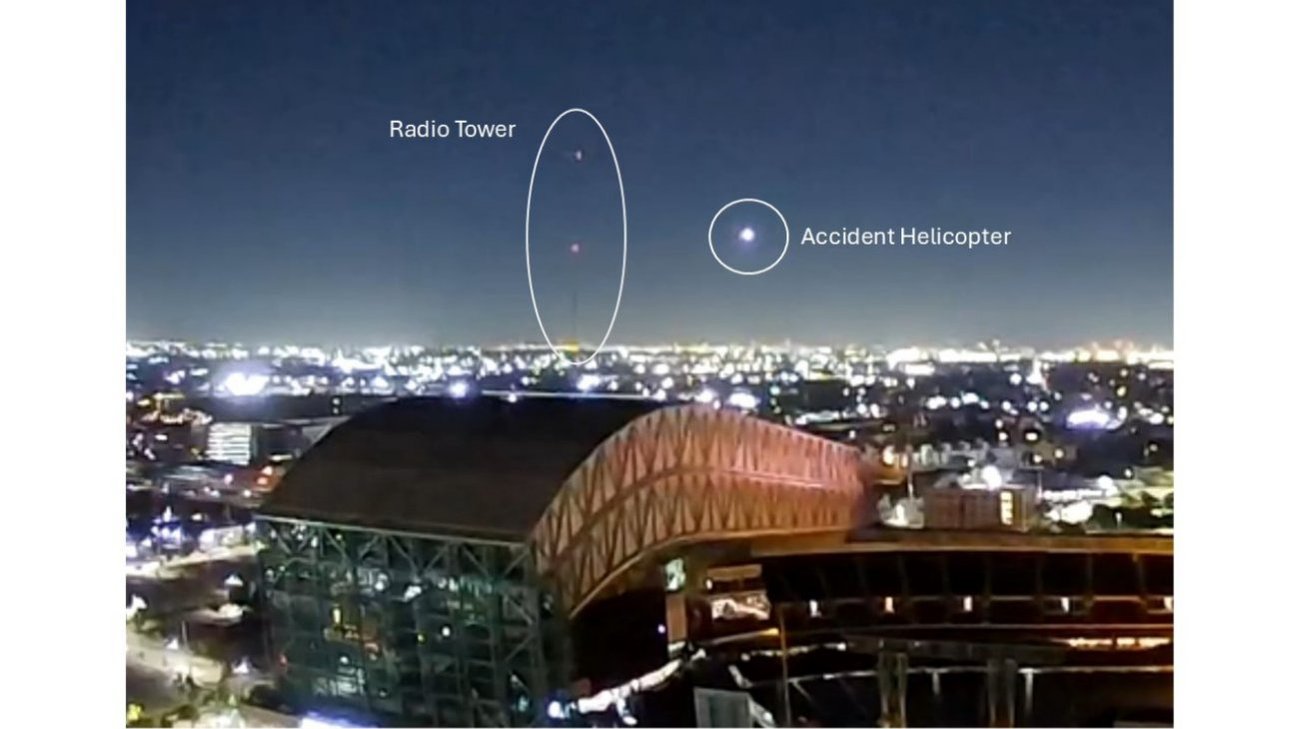
The helicopter had maintained a straight flightpath toward a 1,003-foot radio tower, at an altitude below the tower's top, and struck it about 100 feet below the top. The tower collapsed onto the wreckage, and a post-impact fire destroyed the helicopter. The pilot, 42, and her three passengers were killed. The last ADS-B data point, recorded at 7:51:19 p.m., coincided with the tower's position.
What the NTSB found
The probable cause, in the Board's words: "The pilot's failure to maintain clearance from a lighted radio tower during a visual night flight." Contributing: "the air traffic controller's failure to issue a safety alert notifying the pilot of the flight's unsafe proximity to the tower."
The rest, in short:
- The tower was lit. A NOTAM issued four days earlier reported the tower's lights out of service, yet witness and surveillance video showed the top and intermediate beacons flashing. The NOTAM traced to a recent change of tower ownership. The Board's findings also list an environmental factor, stated only in general terms. The tower was charted as an obstruction and depicted on the controller's own radar display. No safety alert was issued.
- Nothing else failed. Clear night, visibility 10 miles, and no mechanical malfunction or failure that would have precluded normal operation.
- The pilot was experienced — and brand-new. 1,075 total hours, commercial and flight instructor certificates; hired in August 2024, first flight in a company helicopter on September 23, 2024 — about four weeks before the accident. Her husband told investigators she had worked about nine consecutive days. The Board's findings do not cite fatigue.
- There was training — but no program, and no proof. Another company pilot had shown her the tour routes, including flying near high-rise buildings and a 700-foot lighted pole. But the operator had no documented training program — none is required under Part 91 — and, despite multiple requests, never produced the pilot records it said were available. Investigators rebuilt her company flying history from interviews.
- The route was routine. ADS-B data showed the helicopter had flown the same downtown loop seven times between October 17 and 20, five of those flights at or after sunset.
- The gap is structural. The report restates that § 91.147 air tour operators are not subject to oversight comparable to Part 135 — no safety management system — and that the LOA process collects no pilot qualification information and requires no checkrides. Rather than issuing new recommendations, the Board pointed back to its 2021 study of Part 91 revenue passenger operations, AAR-21/03, and the recommendations it made to the FAA there.
(NTSB Aviation Investigation Final Report CEN25FA019, published September 23, 2026. Everything in the sections above is drawn from that report.)
Why this report lands differently in 2026
When this accident happened, a § 91.147 operator had no obligation to run a safety management system. That is no longer the end of the story. The FAA's April 2024 SMS final rule extended 14 CFR Part 5 to § 91.147 Letter of Authorization holders, and existing LOA holders must have an SMS developed, implemented, and declared by May 28, 2027 (14 CFR § 5.9; 89 FR 33068).
So read the Board's description of the structural gap as a description of the past — and of every air tour operator that will still be running on habit when the compliance date arrives. Each fix below is something a small operator can do tonight on its own initiative. Each one is also a piece of the system Part 5 will soon require. Doing it now is not extra work; it is the same work, done before you need it.
The barrier map
Accidents rarely happen because one thing failed. They happen because every layer that could have stopped the sequence was missing, weak, or pointed somewhere else. Here are the layers that stood between this flight and that tower — what the report tells us about each, and what a small SMS would put there.
| Barrier | What the record shows | What a small SMS adds | Part 5 component |
|---|---|---|---|
| Route design | "Downtown loop" was an informal term, not a defined or published route | A written company route with a minimum altitude and named obstructions | Safety risk management |
| Hazard knowledge | Tower charted and on ATC radar; a "lights out" NOTAM four days earlier; beacons actually working | A route obstruction card, updated whenever a NOTAM or chart changes | Safety risk management |
| Pilot readiness | Route training by another pilot; no documented program; records never produced | A one-page program, a training record, and a named sign-off | Safety promotion (training) + documentation |
| Duty and workload | About nine consecutive workdays reported; no fatigue finding | A written duty limit with numbers, kept by the published schedule | Safety risk management |
| In-flight defense | Straight track toward the tower below its top while searching for traffic | A company rule that altitude, not eyesight, protects you from obstacles at night | Safety risk management |
| ATC safety alert | Required of the controller; not issued | Nothing — and that is the point. Plan as if this layer is absent | — |
| Checking the system | No program existed to check | A quarterly file audit and three simple indicators | Safety assurance |
Look at the last column. Six of the seven layers are ones an operator owns. Only one belonged to someone else — and it was the one that failed alongside the pilot.
The SMS lesson (Hank's teaching layer)
Read this report through an SMS lens and one sentence does the damage: not required to have one. Part 91.147 did not require a documented training program, a checkride, or any pilot information on the operator's authorization. Every one of those gaps is a place where a voluntary system would have put paper — and a process — between a new pilot and a night revenue flight. This section is the build. None of it needs FAA permission, and all of it fits a three-pilot operation.
1. "Not required" is not a safety argument
Regulators set floors, not standards of care. The question a jury, an insurer, or an investigator will ask after an accident is never "did the rule require it?" It is "did you have a system, and did you follow it?" A two-page program you actually follow beats a binder you bought — and beats nothing at all by the widest margin in this business.
2. Training happened. Proof didn't — and that is a safety problem, not just a paperwork problem
This is the detail that is easy to miss. The pilot was trained. Another company pilot flew the routes with her and pointed out high-rise buildings and a 700-foot lighted pole. That is real knowledge, passed on in good faith.
But undocumented training has a hidden flaw: nobody can check it for completeness. Was the 1,003-foot tower on that route briefing? Was the downtown loop flown with her at night, or only by day? Did anyone confirm she could fly it alone? The report cannot answer those questions — and neither could the operator. A written syllabus is not there to impress an inspector. It is there so that the owner can look at a list and see what is missing before a passenger is on board.
Apply the one-day test: if an investigator asked tomorrow, could you hand over a complete file for every pilot within one day? If not, you do not have a training system; you have a memory. Before an accident, memory is not management. After one, it is not evidence.
3. A new hire is a change — and changes get a risk assessment
In SMS language, safety risk management is triggered whenever something in the operation changes. Most operators think of "change" as new aircraft, new routes, or new equipment. A new pilot is a change too — and a big one, because experience in general is not experience on your routes, in your aircraft, over your city, at night, narrating to passengers. Each of those is a separate exposure, and a new hire carries all of them at once.
Here is what a ten-minute risk assessment looks like at small-operator size:
- Hazard: a newly hired pilot flying a night city route solo.
- What could go wrong: misjudging distance or height to an obstruction at night; route unfamiliarity combined with high workload (passengers, radio, traffic).
- How bad: catastrophic. How likely, uncontrolled: this report is the answer.
- Controls: night route checkout with a company pilot before solo; a route card naming every obstruction above the route's minimum altitude; a minimum number of supervised night revenue flights; duty limits; a named sign-off.
- Who decides: the owner or chief pilot signs that the controls are in place — before the pilot's name goes on a night schedule.
That is the whole method: name the hazard, rate it, write the controls, and sign that they exist. Hazards with names get controls. Hazards without names get schedule slots.
4. At night, altitude protects you — eyes don't
The Board found the tower's beacons were working, and its findings list an environmental factor, in general terms. The physics is easy to see: two flashing red lights, competing with thousands of other lights. That is the honest physics of night flying over a city. Lit obstacles are not the same as visible obstacles.
So the control cannot be "see and avoid." It has to be geometry. Every company night route should carry a written minimum altitude set above the highest obstruction along it, with a margin you choose and write down — and a rule that the route is flown at or above that altitude unless the pilot can positively identify the obstruction and is clear of it. When you design that way, a missed beacon is a near-miss you never knew about, not a final report.
5. Design for the moment attention is somewhere else
The record shows that in the final minutes, the pilot was searching for traffic that she could see on her ADS-B display but not out the window. We do not know where her eyes or her attention were in the seconds before impact, and the report does not say. But every pilot knows that moment: the radio is busy, a target is on the screen, and your eyes are hunting for it.
That is exactly the moment a written rule earns its keep. A company procedure as simple as "While searching for traffic, hold altitude at or above the route minimum; if you cannot find the traffic, turn away from known obstructions or ask ATC for help" takes a decision off the table at the worst possible time. Good procedures are not for the calm part of the flight. They are for the part where your attention has been taken.
6. A NOTAM is information, not reassurance
Four days before the accident, a NOTAM said the tower's lights were out. In fact they were working; the NOTAM traced to an ownership change that broke the tower's electronic reporting. The Board does not say the NOTAM affected the pilot, and we do not suggest it did.
The teaching point is about data. Obstruction information goes stale: towers change hands, lighting monitors break, new structures go up. A small operator's defense is a habit, not a database: when a NOTAM or chart change touches one of your routes, the route card gets reviewed, the change gets briefed, and the minimum altitude is re-checked. A "lights out" NOTAM should make you more conservative about that obstacle — never less.
7. Never let ATC be your last barrier
The controller owed this flight a safety alert and didn't issue it — and the probable cause still begins with the pilot. A safety alert depends on someone else's screen, someone else's workload, someone else's attention. Brief your routes and set your minimum altitudes as if the frequency will stay silent — because one night, it will.
The two pages, sketched
Page 1 — the program. What a new hire completes before flying revenue passengers solo:
- Company indoctrination — your operation, your airspace, your emergency procedures, your duty rule, and how to report a safety concern.
- Aircraft differences — your equipment, your configuration, your avionics (including how and when to use the ADS-B display).
- Route familiarization — every route the pilot will fly, by day and again at night, because they are different routes after dark. Each route card reviewed and initialed.
- Supervised revenue flights — a minimum number with a company pilot, including night flights if the pilot will fly at night.
- Final sign-off — by name, from the chief pilot or owner, stating which routes and which conditions (day / night) the pilot is released for.
One page, five blocks, no legal language.
Page 2 — the record. One line per training event: date, item covered, instructor, result, both signatures. That page is the pilot file's spine. Add:
- copies of certificates and medical;
- the signed route releases (day / night);
- the duty log;
- any safety reports the pilot filed or was involved in.
Now you hold exactly the file the NTSB asked this operator for. Under Part 5 you will also need to keep SMS records — including training records — for defined periods, so a habit of writing the line the same day the training happens will carry straight into compliance. Total cost: a folder and the discipline to write the line on time.
A duty rule you can copy tonight
The report records about nine consecutive workdays, reported by the pilot's husband, and makes no fatigue finding. Draw your own line before a schedule draws it for you. Hank's template — adapt the numbers to your operation, but write numbers, not adjectives:
Notice what that paragraph does: it makes fatigue a scheduling rule instead of a personal judgment call at 7 p.m. on day nine, and it makes the schedule itself the evidence that the rule was kept.
One card per route
The Houston route had a 1,003-foot tower on its line. A route obstruction card names that hazard before the first night flight, not after:
- Route name — a defined company route, not a local nickname;
- Highest obstruction and its height;
- Minimum altitude for flying the route, day and night;
- Lighting — what is lit, what is not, and the date the NOTAMs were last checked;
- Escape direction — which way to turn if you lose sight of the obstruction or the traffic;
- Briefed by / date — who walked a pilot through this card, and when.
Six lines, laminated, kept with the aircraft documents. When a route changes — new construction, a new tower, a NOTAM — the card changes, and the change gets briefed.
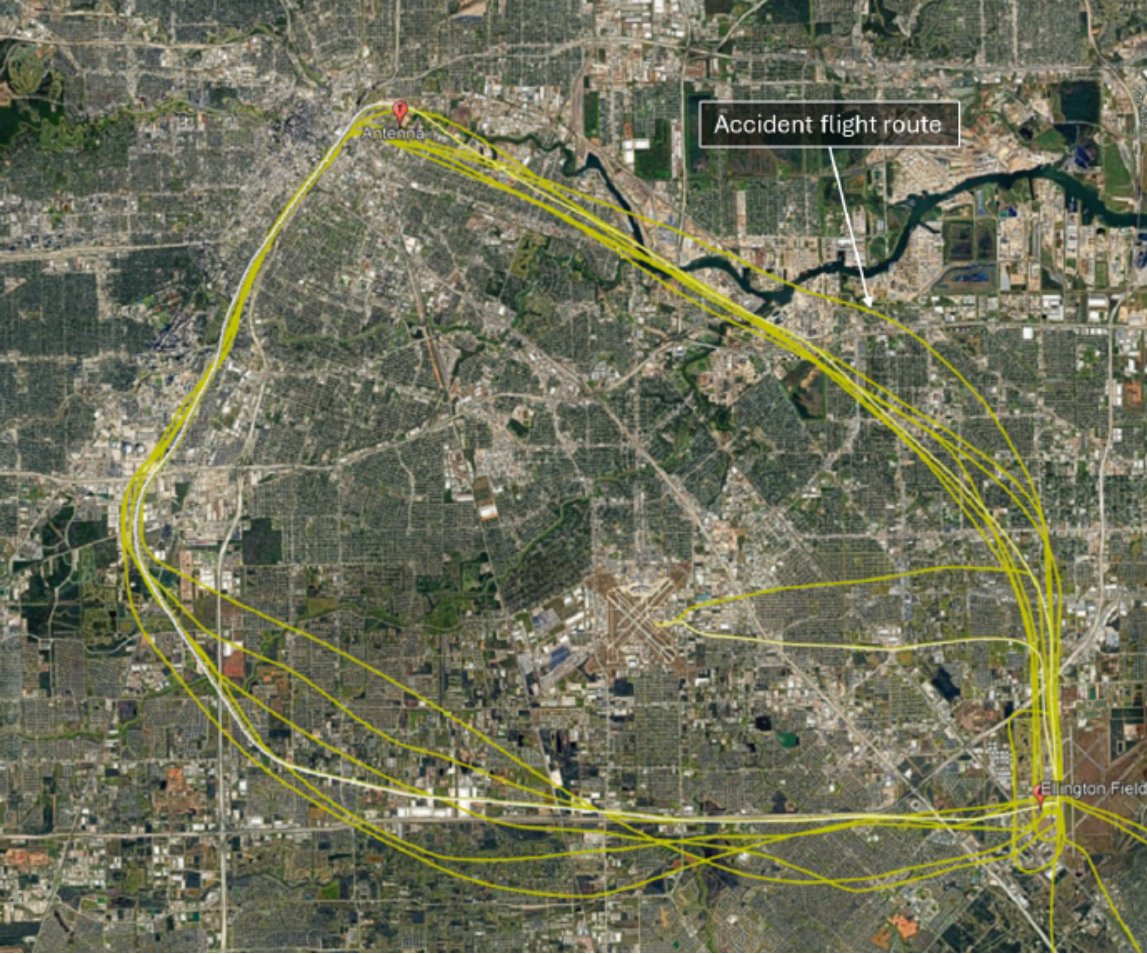
Seven flights in four days is what "routine" looks like. Routine routes are exactly where informal knowledge quietly replaces written knowledge — everyone "knows" the loop, so nobody writes it down. The card is how a routine route stays a managed one.
Assurance, in miniature
SMS has a component small operators skip because it sounds corporate: safety assurance — checking that your own system works. Here is the whole loop, small-operator size.
Once a quarter, pull one pilot file at random and audit it against your own two pages: every block signed, every route release current, duty log complete. Write down what you found — including "nothing missing" — date it, and fix what is short. Thirty minutes, four times a year.
Track three numbers. You do not need software; a sheet of paper on the wall will do:
- Route releases current — what share of your pilots are signed off, day and night, on every route they are scheduled to fly? The target is 100%.
- Duty-rule exceptions — how many times this quarter did a pilot exceed your written duty limit? Every exception gets a one-line reason.
- Route cards reviewed after changes — when a NOTAM or chart change touched a route, was the card updated and briefed within a week?
If this operator had run that loop once, the missing program and the missing records would have been their finding to fix, on a quiet Tuesday — not the NTSB's, in a final report.
Make it safe to say "not yet"
The fourth SMS component is safety promotion, and at small-operator size it comes down to one question: would your newest pilot tell you she is not ready?
New hires are the people least likely to speak up. They want the job, they want to look capable, and they know the schedule needs them. So say it out loud, and put it in the indoctrination block: "Telling us you are not ready for a route, a time of day, or another duty day is part of the job. Nobody is penalized for it." Then prove it the first time someone uses it. A reporting culture is not a poster. It is the owner's reaction to the first awkward phone call.

Hank's Take
A certificate tells you a pilot can fly. It doesn't tell you she knows your routes, your city, your towers — at night, narrating to passengers. The distance between "legal to hire" and "ready to fly your line" is where small operators live or die. Close it with paper: a program, a record, a sign-off. And if you fly under § 91.147, start now — by May 28, 2027, closing that distance stops being a choice.
Your move — ten minutes
Minute one: open the folder — or the drawer — where your pilot records live. Could you hand an investigator a complete file for every pilot tomorrow morning: certificates, training completed, route releases, duty days? If the honest answer is "mostly," you have found your next safety project.
Minutes two to five: write your maximum consecutive duty days, sign it, and date it. You have just written the first paragraph of the training program the regulation never made you write — and the first entry in the SMS it soon will.
Minutes six to ten: pick your most-flown night route and write its card — highest obstruction, minimum altitude, what is lit and what is not, which way to turn. Next quarter, pull one pilot file and check it against your own pages.
That is the whole system: program, record, rule, card, check. It starts tonight, and it fits on an index card's worth of paper — which is four pages more than the operator in this report could show the NTSB.
Sources
- NTSB, Aviation Investigation Final Report CEN25FA019 (Robinson R44 II, N881KE, Houston, Texas, October 20, 2024), published September 23, 2026.
- NTSB, Safety Study AAR-21/03 — revenue passenger-carrying operations conducted under 14 CFR Part 91 (2021).
- FAA, Safety Management Systems final rule, 89 FR 33068 (April 26, 2024); 14 CFR Part 5, including § 5.9 (compliance dates).
- FAA Order JO 7110.65, Air Traffic Control — safety alerts.
Hank's Classroom is published by HAN Aviation Safety Consulting for educational purposes. Case facts are drawn from the NTSB's public record; the analysis and recommendations in the teaching layer are ours and are not the Board's. Nothing here is legal advice or a substitute for your own operation's risk assessment.
Want the full lesson?
Hank's Classroom is the appetizer. Our live training programs go deep — 16 to 24 hours, built around your operation.